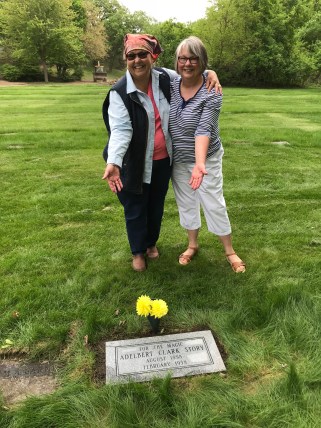
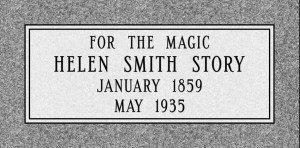

In my heart, all’s a little bit righter with the world because on May 22, 2018, Hapie and Lalu received headstones–just 80+ years late. Kris, Blair, David and I were present at the installation, by sexton Mark. Kris brought dahlias, one of Lalu’s favorite flowers, for each of the graves.
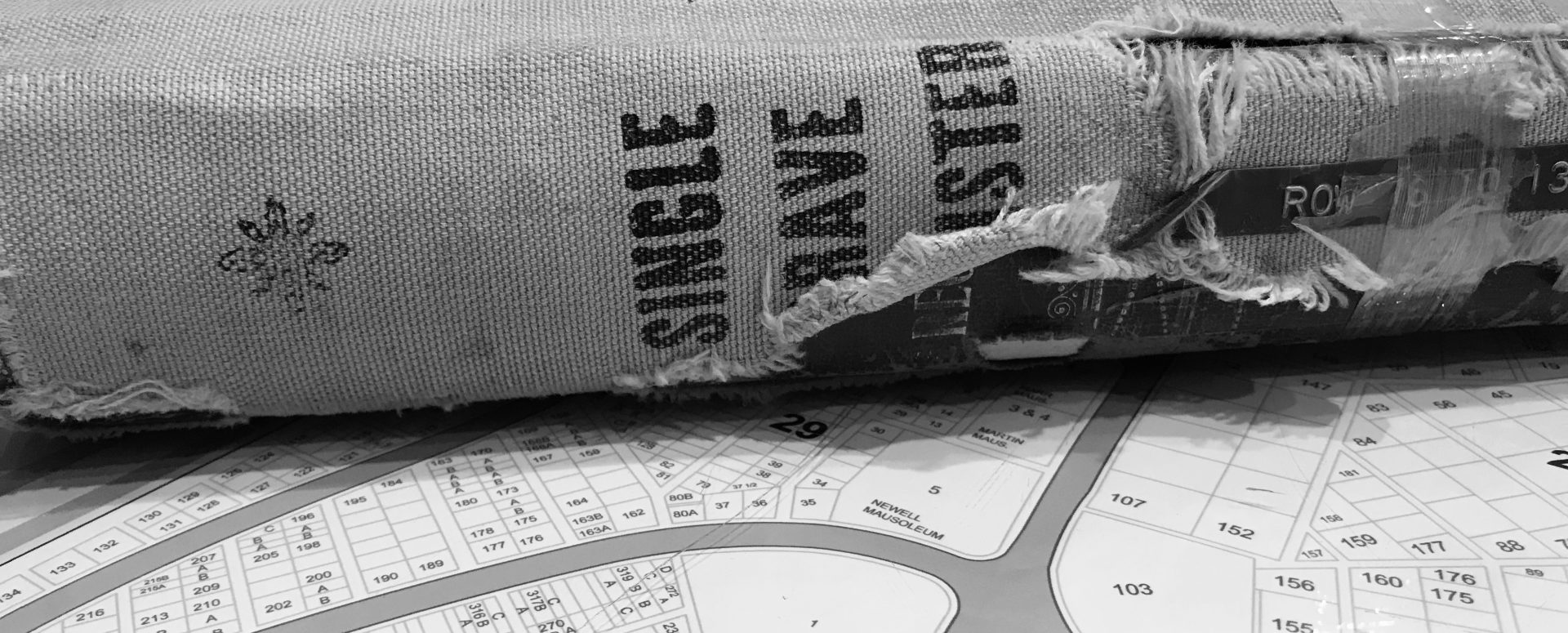
I’m the least interested in graves of anyone I know, but mysteriously, when Kris and I discovered them buried in the PG (Pauper’s Grave) section of Lakewood Cemetery AND had no stones, the wrongness of it just hit me and I knew I wanted to fix this. Even though they died long before we great grandchildren were born, the stories about them are still strong. While I wanted to just do this simply, on my own, once the other grandchildren heard about it, they wanted to contribute to the project too. Thank you!
“For the Magic” seemed a fitting title (to me, at least) because Hapie and Lalu built the cottage on Casco Point, leading Minnie and Pa to have their home a few doors down, and THAT house was the most magical place in my young life. The house (with its upstairs, fireplace, sunroom, and front hall closet with a lightbulb-and-a-string) and the lake and the flowers and all the family parties. I am so very grateful for those memories.
And here are the write-ups I did for Hapie and Lalu that will be added to the Lakewood website (under “visiting” then “burial search”). Thank you cousins for the the details included here!
Helen Smith Story (Hapie)
Hapie was born January 1859 in Wisconsin to Caroline Hoskins Smith (24) and Elbridge Smith (38), who were originally from Maine. Caroline was “very British,” as was Hapie. Elbridge graduated from Bowdoin College and was an attorney.
Hapie met Lalu in North Dakota, where she had gone with a friend who wanted to visit her boyfriend. In 1886 Hapie and Lalu were married by the bishop in Menasha, Wisconsin. They moved to Minnesota and had two sons: Donald (1889) and Elbridge (1894).
One summer when their sons were young, Hapie and Lalu rented a cottage on Gray’s Bay on Lake Minnetonka. In 1906 they bought the land ($500) for their eventual beloved summer cottage on Casco Point. Until they got a car, they’d take the train back and forth. Every summer Hapie would bring all her Haviland china and silverware out to the cottage on the train. Streetcar boats met passengers at the lake and took them to their lakeshore cottages.
After Lalu lost his job, he and Hapie lived with Elbridge’s family, at the cottage in the summer and in Minneapolis for the winter. Elbridge and his wife Irma eventually bought a home a few doors down from the cottage to raise their family. Hapie loved to read the classics (like The Jungle Book) to the grandkids. She’d sit in the sunroom mending—she did all the mending for the family—and dry her long hair. When it was dry, she’d wrap it up in a pompadour. Hapie also was known for having no financial sense, even during the Depression she never got the concept of scrimping.
Having fallen and hurt her hip at some point, Hapie was lame but refused to go to the doctor. The last year of her life she was in a lot of pain but never complained. The day before she died, she stayed in bed all day, saying she didn’t feel well. That night she fell in the bathroom and was gone. She died May 5, 1935, at the age of 76; her death certificate listed the cause of death as “myocarditis.”
Though Hapie and Lalu were long gone by the time their great grandchildren came along, those kids are still so grateful they got to share the magic of that special home on Casco Point, Lake Minnetonka.
Adelbert Clark Story (Lalu)
Lalu was born August 1858 in Waterloo, New York to Harriet Estelle Clark (26) and Charles Edward (25). He had seven siblings. Little is known about his family beyond that it was large, probably quite poor, and they lived in Michigan. Lalu told a story about his mother’s schoolteacher friend who brought a book to their house when he was a young boy—he thought it was the most wonderful thing he’d ever experienced. He graduated from the University of Michigan.
Hapie and Lalu met in North Dakota where he was a teacher in a country grade school. She had accompanied a friend to North Dakota so the friend could visit her boyfriend. In 1886, the bishop married them in Menasha, Wisconsin. At some point they moved to North Minneapolis and had two sons, Donald (1889) and Elbridge (1894). Lalu worked as a wholesale grocery salesman most of his life.
One summer, when their sons were still boys, Hapie and Lalu rented a cottage on Gray’s Bay on Lake Minnetonka. In 1906 they bought the land ($500) for their eventual beloved summer cottage on Casco Point. They had the cottage built but Lalu did a lot of the work. Over time, Lalu added another bedroom and a wraparound porch to cottage to accommodate the growing number of grandkids. Until they got a car, they’d take the train back and forth. Streetcar boats met passengers at the lake and took them to their lakeshore cottages.
The grandkids remember Lalu as tall (6 feet), bald, with a small mustache and “great big feet.” He was a quiet, gentle person—good, serious, scholarly. He never swore; the worst he’d call anyone was a “darned gink,” and then he had to be really mad. Lalu was also an active person—he walked a lot, he could “walk forever.” He also enjoyed gardening, including growing peanuts on the beach at the lake, and swimming.
After Lalu lost his job, he and Hapie lived with Elbridge’s family, at the cottage in the summer and in Minneapolis for the winter. Elbridge and his wife Irma eventually bought a home a few doors down from the cottage to raise their family.
Lalu died February 28, 1938, at the age of 80. His death certificate listed the cause of death as “chronic myocarditis with hypertension;” he also had dementia several years before his death.
Though Hapie and Lalu were long gone by the time their great grandchildren came along, those kids are still so grateful they got to share the magic of that special home on Casco Point, Lake Minnetonka.
 Our Family Stories
They’re springing back to life in us!
LikeLike
I am a WWI Military Historian and was walking through Lakewood Cemetery section PG21 looking at Minnesotans who served in WWI when I came across the grave marker for Adelbert Clark Story. I saw the epitaph “For the Magic” and wondered why that was on the grave marker. A google search when I got home led me to this page. I did not see the one for Helen, but the next time I am in that section I will look for her and pay my respects to both. It is indeed a great legacy to be remembered for the love and magic. From the wonderful description above, it is easy to picture them and I will pass their way with a smile making sure to say their names. Thank you for sharing a bit about their personality.
LikeLiked by 1 person
What a delightful note, Susi! It makes my day! Karen
LikeLike